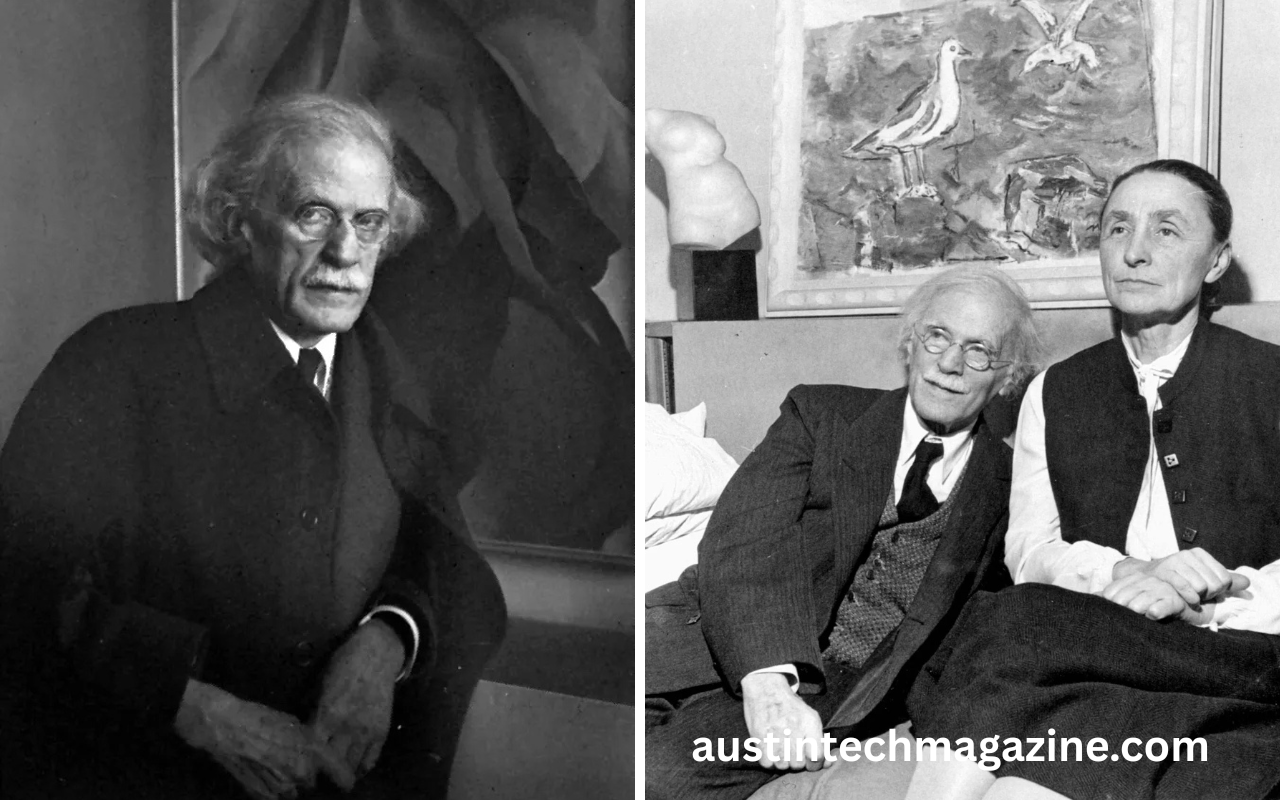
Alfred Stieglitz was one of the most influential figures in the history of photography and modern art. Known as a visionary photographer, publisher, curator, gallery owner, and promoter of artistic innovation, Stieglitz played a central role in transforming photography from a mechanical process into a respected form of fine art. Throughout his remarkable career, he championed artistic freedom, introduced modern European art to American audiences, supported emerging artists, and produced some of the most iconic photographs ever created.
His influence extended far beyond his own photographs. Through publications such as Camera Work, organizations such as the Photo-Secession movement, and galleries like 291, Stieglitz helped shape the direction of twentieth-century art. Today, historians regard him as one of the most important cultural figures in American art history.
Early Life and Childhood
Alfred Stieglitz was born on January 1, 1864, in Hoboken, New Jersey, to Edward Stieglitz and Hedwig Ann Werner Stieglitz. His family was wealthy and culturally sophisticated, having immigrated from Germany. His father was a successful wool merchant who valued education and intellectual development.
Growing up in a financially secure household allowed Alfred to pursue his interests freely. His parents encouraged learning, travel, and exposure to European culture. These experiences would later shape his artistic outlook and contribute significantly to his success.
During his childhood, photography was still a relatively new invention. Few people could have imagined that the medium would eventually become one of the world’s most important artistic forms. Even fewer could have predicted that Alfred Stieglitz would become one of its greatest champions.
Education in Europe
In 1881, the Stieglitz family relocated to Europe. This move proved life-changing for Alfred. He enrolled at the Technische Hochschule in Berlin, where he initially studied mechanical engineering.
While studying engineering, Stieglitz developed a fascination with photography. He purchased his first camera and began experimenting with photographic techniques. Under the mentorship of renowned scientist Hermann Wilhelm Vogel, he learned the technical aspects of photography while simultaneously exploring its artistic possibilities.
Unlike many photographers of the era, Stieglitz believed photography could be used to communicate emotion, beauty, and personal vision. He traveled extensively through Germany, Italy, France, and the Netherlands, photographing landscapes, city scenes, architecture, and everyday life.
His photographs quickly gained recognition in European competitions. During the late 1880s, he won numerous awards and established himself as one of the most promising young photographers in the world.
Early Photographic Philosophy
From the beginning, Stieglitz viewed photography differently than most of his contemporaries. Many photographers considered the camera a tool for documentation. Stieglitz believed it could become an instrument of artistic expression.
He argued that photographers should make creative decisions regarding composition, lighting, timing, and subject matter. These artistic choices transformed photography into something much more meaningful than a simple record of reality.
This philosophy would define his entire career.
Stieglitz believed that a photograph should reveal the photographer’s vision and emotions. He sought images that communicated atmosphere, mood, and beauty rather than merely documenting facts.
Return to America
When Stieglitz returned to the United States in 1890, he found an American photography community focused primarily on technical perfection rather than artistic innovation.
Determined to change public perceptions, he became deeply involved in photographic organizations and publications. He quickly emerged as one of the leading voices advocating for artistic photography.
At a time when many critics dismissed photography as a mechanical process, Stieglitz argued passionately that it deserved recognition alongside painting and sculpture.
His leadership would eventually spark a revolution in the art world.
Pictorialism and Artistic Photography
During the late nineteenth century, artistic photography was dominated by a movement known as Pictorialism.
Pictorialist photographers sought to create images that resembled paintings. They often used soft focus, atmospheric lighting, and specialized printing techniques to produce artistic effects.
Stieglitz became one of the movement’s most important leaders. His photographs from this period emphasized beauty, mood, and emotional expression.
Some of his most celebrated early works include:
Winter, Fifth Avenue (1893)
This photograph captures New York City during a snowstorm. The image demonstrates Stieglitz’s mastery of composition and atmosphere.
The horse-drawn carriage emerging through falling snow creates a dramatic and poetic scene that transformed an ordinary street into a work of art.
The Terminal (1893)
Another iconic image, The Terminal depicts horses and streetcars amid steam and winter weather.
The photograph highlights Stieglitz’s fascination with urban life and his ability to discover beauty within everyday scenes.
Spring Showers (1900)
This image showcases Stieglitz’s skill in capturing weather conditions and human activity. The photograph reflects his belief that photography could convey mood and emotion.
The Photo-Secession Movement
In 1902, Alfred Stieglitz founded the Photo-Secession movement.
The organization’s purpose was simple yet revolutionary: promote photography as a fine art.
The movement rejected conventional photographic standards and encouraged creativity, experimentation, and artistic expression.
Photo-Secession attracted many talented photographers, including:
- Edward Steichen
- Clarence H. White
- Gertrude Käsebier
- Alvin Langdon Coburn
Together, these artists challenged traditional views of photography and established new standards for artistic excellence.
The movement played a critical role in changing public attitudes toward photography.
Camera Work Magazine
One of Stieglitz’s most important achievements was the creation of Camera Work in 1903.
The quarterly publication became one of the most influential magazines in photographic history.
Each issue featured:
- High-quality photographic reproductions
- Critical essays
- Artist interviews
- Exhibition reviews
- Discussions about art and aesthetics
Stieglitz insisted on exceptional printing standards. The magazine’s photogravures were widely regarded as masterpieces of reproduction.
Camera Work became a platform for promoting artistic photography and introducing readers to modern art movements.
Even today, original copies remain highly valued by collectors and museums.
Gallery 291 and the Modern Art Revolution
In 1905, Stieglitz opened the Little Galleries of the Photo-Secession at 291 Fifth Avenue in New York City.
The gallery eventually became known simply as “291.”
Initially dedicated to photography, the gallery soon expanded to include painting, sculpture, and modern art.
Through 291, Stieglitz introduced Americans to many groundbreaking European artists, including:
- Pablo Picasso
- Henri Matisse
- Paul Cézanne
- Auguste Rodin
- Henri de Toulouse-Lautrec
At the time, these artists were virtually unknown in America.
The exhibitions organized by Stieglitz helped prepare the American public for the arrival of modernism.
Many art historians consider 291 one of the most important galleries in American history.
Alfred Stieglitz and Modernism
Stieglitz became a leading advocate for modern art.
He believed artists should reject outdated traditions and create work that reflected contemporary life and personal experience.
His support extended to numerous American modernists, including:
- Arthur Dove
- Marsden Hartley
- John Marin
- Charles Demuth
- Georgia O’Keeffe
Through exhibitions and promotion, Stieglitz helped establish modernism as a major force in American culture.
His influence reached far beyond photography and transformed the broader art world.
The Steerage: His Greatest Photograph
Among all of Stieglitz’s photographs, none is more famous than The Steerage.
Taken in 1907 aboard a ship traveling from Europe to America, the image depicts passengers in steerage class below the upper decks.
The photograph combines social commentary with extraordinary visual design.
Strong geometric shapes, intersecting lines, and carefully balanced forms create a composition that feels both modern and timeless.
Stieglitz later described the photograph as a turning point in his artistic development.
Today, The Steerage is considered one of the greatest photographs ever created and a landmark achievement in modern photography.
Marriage to Georgia O’Keeffe
One of the most significant relationships in Stieglitz’s life was with artist Georgia O’Keeffe.
Their connection began in 1916 when Stieglitz saw O’Keeffe’s drawings and immediately recognized her talent.
He exhibited her work and encouraged her artistic development.
Their professional relationship gradually evolved into a romantic partnership.
The two married in 1924 and remained connected for the rest of Stieglitz’s life.
Together, they formed one of the most influential artistic couples in American history.
The O’Keeffe Portrait Series
Stieglitz photographed Georgia O’Keeffe hundreds of times over two decades.
The resulting collection is among the most important portrait projects in photographic history.
The series includes:
- Formal portraits
- Close-up studies
- Artistic nudes
- Hand studies
- Environmental portraits
Rather than creating a single definitive image, Stieglitz sought to reveal the many dimensions of O’Keeffe’s personality.
The project demonstrated his belief that a person’s identity could only be understood through multiple perspectives over time.
Straight Photography
As his career progressed, Stieglitz gradually moved away from Pictorialism.
He began advocating for what became known as Straight Photography.
This approach emphasized:
- Sharp focus
- Clear detail
- Honest representation
- Strong composition
- Minimal manipulation
Stieglitz believed photography should embrace its unique strengths rather than imitate painting.
His transition toward Straight Photography helped shape the future of modern photographic practice.
Many later photographers adopted similar principles.
The Equivalents Series
During the 1920s and 1930s, Stieglitz created one of his most innovative projects: the Equivalents series.
These photographs depicted clouds and sky formations.
At first glance, the images appear simple. However, Stieglitz intended them to express emotional and spiritual states rather than merely record weather conditions.
The series is often considered one of the earliest examples of abstract photography.
Through Equivalents, Stieglitz demonstrated that photography could communicate ideas and emotions without relying on recognizable subject matter.
The project remains highly influential among contemporary photographers and artists.
New York City as a Subject
Throughout his career, New York City served as one of Stieglitz’s favorite subjects.
He photographed:
- Streets
- Buildings
- Transportation systems
- Crowds
- Bridges
- Weather conditions
His urban images captured the transformation of America into a modern industrial society.
Rather than simply documenting change, he interpreted the city through an artistic lens.
His photographs remain valuable historical records while also standing as significant works of art.
Later Galleries
After the closure of 291, Stieglitz continued supporting artists through new exhibition spaces.
These included:
The Intimate Gallery
Opened in 1925, this gallery showcased modern American artists and provided an important venue for experimentation.
An American Place
Established in 1929, this gallery became Stieglitz’s primary platform for promoting American modernism.
Many artists associated with Stieglitz achieved lasting success through exhibitions held there.
Relationship with Ansel Adams
In the 1930s, Stieglitz recognized the extraordinary talent of photographer Ansel Adams.
He organized exhibitions of Adams’s work and helped introduce him to influential collectors and critics.
This support contributed significantly to Adams’s rise as one of America’s most celebrated photographers.
The relationship symbolized the passing of artistic leadership from one generation to another.
Personal Life and Challenges
Although enormously influential, Stieglitz faced numerous personal and professional challenges.
His strong opinions often created conflicts within artistic communities.
His marriage to Georgia O’Keeffe experienced periods of strain due to health issues, geographic separation, and personal differences.
Despite these difficulties, both artists remained deeply committed to their work.
Their relationship continues to fascinate historians and biographers.
Final Years
By the late 1930s, Stieglitz’s health had deteriorated significantly.
He suffered several heart attacks and gradually reduced his photographic activities.
Nevertheless, he continued promoting artists and managing exhibitions.
His dedication to modern art remained unwavering.
On July 13, 1946, Alfred Stieglitz died in New York at the age of eighty-two.
His death marked the end of one of the most influential careers in art history.
Legacy and Lasting Influence
Alfred Stieglitz’s impact on photography and modern art cannot be overstated.
His achievements include:
- Elevating photography to fine-art status
- Founding the Photo-Secession movement
- Publishing Camera Work
- Establishing Gallery 291
- Promoting modernism in America
- Supporting Georgia O’Keeffe and numerous artists
- Creating some of the most iconic photographs ever made
Without Stieglitz, photography might have taken decades longer to achieve acceptance as a respected artistic medium.
His influence continues to shape photography, museums, galleries, and art education around the world.
Alfred Stieglitz’s Most Famous Photographs
Some of his most celebrated works include:
- The Steerage (1907)
- Winter, Fifth Avenue (1893)
- The Terminal (1893)
- Spring Showers (1900)
- The Hand of Man (1902)
- Flatiron Building (1903)
- From the Back Window, 291 (1915)
- Equivalent Series (1920s–1930s)
- Georgia O’Keeffe Portrait Series
- Lake George Photographs
These images continue to be studied by photographers, historians, and students worldwide.
Conclusion
Alfred Stieglitz transformed photography from a mechanical process into a respected form of artistic expression. Through his photographs, publications, galleries, and tireless advocacy, he changed the history of art forever. His commitment to innovation helped introduce modernism to America, support emerging artists, and establish photography as one of the defining artistic mediums of the modern era.
More than seventy years after his death, Alfred Stieglitz remains a towering figure whose vision continues to inspire photographers, artists, and creative thinkers across the globe. His work serves as a reminder that true artistic innovation requires courage, persistence, and an unwavering belief in the power of creative expression.
you may also read :How Mae Capone Met Al Capone